
First-Time Puppy Parents
You feel exhausted by daily leash pulling and want a gentle, clear way to enjoy peaceful neighborhood walks together.
FOR FIRST-TIME PUPPY OWNERS
Learn the simple six-phase routine to take calm neighborhood walks with your puppy, without leash corrections or arm strain.
Get Access Now6 phases · 24 lessons
You step outside and your puppy instantly hits the end of the leash. Your arm aches, your hands hurt, and your morning stroll turns into an embarrassing wrestling match on the sidewalk. You pull back to slow them down, but they only dig in and pull harder.
Here is the surprising truth. Your puppy is not being stubborn, and you are not doing it wrong. The real issue is reacting after the leash is already tight. Dogs have a natural reflex to push against pressure. When you tug back, their body tells them to lean forward with even more force.
You miss the single second before tension happens. Because no one showed you how to catch that tiny window, daily walks feel like an exhausting tug-of-war.
You do not need force, prong collars, or constant treats glued to your puppy's nose. You only need a simple way to guide your puppy before the leash tightens. Our step-by-step system builds calm habits inside your living room first, then brings that ease straight onto your street.
Instead of fighting for control, you reward calm focus right at your side. You learn simple responses like Stand like a Tree and Give and Go. Tension disappears before it can even start, letting your puppy explore and walk with you as a team.
Picture clipping on the leash and walking down your street with coffee in one hand. The leash hangs in a gentle, loose curve. You pass neighbors and other dogs with total confidence and peace of mind.
You feel exhausted by daily leash pulling and want a gentle, clear way to enjoy peaceful neighborhood walks together.
You tried stopping in place or buying special harnesses, but your puppy still drags you down the sidewalk every morning.
You want reliable walking habits without resorting to harsh collar jerks, painful tools, or physical force.
End Daily Arm Strain:
Stop wrestling for control on the sidewalk. You will learn how to keep the leash resting loosely in one hand while your puppy walks calmly at your side.
Zero Jerks Or Harsh Corrections:
Protect your bond with your puppy. You will guide good walking habits using clear, gentle steps instead of painful collar pops or force.
Enjoy Peaceful Sniff Breaks:
Give your puppy freedom without losing control. You will master an easy rhythm that balances relaxed sniffing with focused forward walking.
Five-Minute Practice That Fits Your Day:
Skip hours of tiring drills. Simple indoor micro-steps build real habits on your living room floor before you face busy street distractions.
Start in your living room with zero distractions. You will master the exact body cues your puppy shows right before the leash tightens, so you can guide them before pulling starts.
Teach your puppy that walking by your side is the most rewarding spot. You will learn simple hand mechanics and reward pacing that keep the leash hanging loose naturally.
When distractions happen, use simple responses like Stand like a tree and Give and Go. You will stop pulling without jerking the leash or raising your voice.
Bridge the gap between your front door and the sidewalk. Add structured sniff breaks along your route so you can walk a full neighborhood block on a relaxed slack leash.
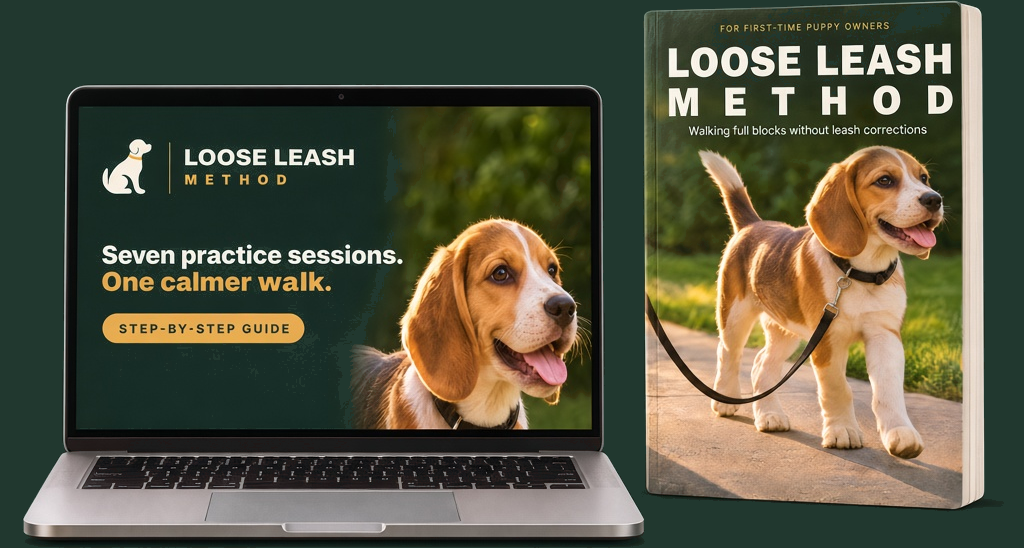
Price: $149 one-time payment
Get Access NowYou clip the leash to your puppy's collar and open the front door. There is no lunging. There is no frantic pulling. You step onto the sidewalk together, and the leash hangs between you in a relaxed, gentle J-curve.
You take your first ten steps, then twenty, and make it all the way down the sidewalk. Your hands rest comfortably at your side with zero wrist strain and zero sore shoulders. When your puppy spots a rustling bush, you pause smoothly. You use your simple pre-tension cue, and your puppy turns right back to match your stride. Neighbors smile as you pass by, watching you guide your calm companion a full neighborhood block with one hand.
Now, consider the alternative.
If you keep guessing on every walk, daily outings remain an exhausting tug-of-war. Every time your puppy pulls against a tight leash, their natural reflex to pull harder gets stronger. In a few months, that energetic puppy becomes a strong, fully grown dog who still drags you toward every scent, dog, and distraction.
You do not need endless hours or natural training talent to fix this. You just need five minutes a day and a clear, correction-free sequence that teaches your puppy how to keep the leash slack on their own.
Yes. High-energy puppies pull because the outside world overloads their senses before they understand leash mechanics. That is why you start inside your living room first where distractions are low. Once your puppy learns how to find slack beside you indoors, we bridge those habits step by step onto quiet outdoor sidewalks.
Not at all. Puppies have short attention spans and shut down during long practice drills. You only need short, five-minute micro-sessions that fit naturally into your normal routine. You simply practice a few steps before breakfast or during regular potty breaks.
Constant food luring is only a bribe, not a learned skill. This system uses a structured step progression that fades out constant treats right from phase two. Your puppy learns to walk on a loose leash because slack earns forward movement, not because you keep a piece of meat glued to their nose.